

Planning a reunion can be a challenging and daunting task, however armed with this book, we guarantee to help make your job a lot easier. We will address all of the elements that are critical to having a successful reunion from start to finish. You will benefit from the information in this book whether you are only considering having a reunion or if your planning is already well under way. In either case, you will find great tips and ideas to make your reunion a success.
The suggestions in this book apply to a reunion with as little as 50 classmates or more than 500, and they are valid if you are planning a 5-year reunion or a 50-year reunion. Most reunions occur around milestone anniversaries such as the 10-year, 20-year or 30-year mark, although odd-numbered years work as well.
In the following chapters, we provide you with critical information needed to keep you on track and on budget so that you can have the best reunion possible.
Some of the things we will cover in this book include:
High school reunion planning in the 21st century has been greatly facilitated thanks to the internet. The World Wide Web has made it much easier to search for classmates, vendors, favors, and do all kinds of research to help plan the event. The Web has also made communicating with classmates and collecting information so much easier than it was prior to the internet age.
The best way to correspond with classmates is through a reunion website that acts as a communications center where you can disseminate important reunion details, collect information, sell tickets, create a buzz, and so much more.
In the past, creating a website required someone with the technical knowledge and skills of an experienced computer programmer. Thanks to do it yourself reunion website builders like the one at MyEvent.com, the task of creating a reunion website has been made extremely easy. One of the chapters in this book will be devoted to getting the most out of your website, and throughout the book we will throw in tips on how your website can help with your reunion planning.
Today, more people are online than ever before. With the increasing popularity of social networks such as Facebook, LinkedIn, and Twitter, there’s a whole new way of getting the word out. We will explore social media in Part III Getting the Word Out.

This section summarizes the step-by-step instructions on planning your reunion. To ensure you have sufficient lead-time, you should ideally start planning 12 months in advance of the event. If you only have six months or less, you can still pull it off but you may need to adjust your timeline accordingly. We will go into each of these steps in depth later in the book.
STEP 1: Recruit Committee Members
The first step in planning your reunion involves evaluating if there is enough interest in having a reunion. This requires that someone take the initiative to get the ball rolling (which is most likely you, if you are reading this book!). This may seem like an obvious step, but some people overlook it and jump right into the actual planning before having addressed this fundamental point.
To know if you have the prerequisites for a successful reunion, you should know if you will be able to form a committee. This is not absolutely necessary, but if you are planning a reunion entirely alone you will need a lot of free time. Make a few phone calls to former classmates to recruit potential committee members. We will examine the key elements in forming a committee and what the committee does later in this chapter.
If you can get a committee together and you are commemorating a milestone reunion, your chances are pretty good for generating a lot of interest in a reunion. There is a natural tendency for people to want to reacquaint with old friends and see what paths people took since having graduated from high school.
STEP 2: Create A Website
At this stage, you want to start to create some interest in the reunion. Build your website and start uploading content. The more content that you can put on the website the better.
Classmates who visit the website will see it as a sign that you are serious about the reunion and will help to spread the word.
Reunions are about nostalgia, so putting up a lot of pictures and stories from high school is highly recommended. Include a page that reflects back to the time when you graduated. It’s very easy to find pictures and information for the year that you graduated on sites like Wikipedia.com, Brittanica.com, and other encyclopediarelated websites.
You should post a message that tells visitors you are in the early stages of planning the reunion. Invite everyone who visits the website to register on the Classmates page and to tell their friends about the website. Encourage people to come back often as there will be many updates in the coming weeks and months.
STEP 3: Prepare Business Cards
If you are planning a reunion of a significant size, you may want to create business cards with the name of the school, the reunion year, and your school mascot on them. Also include the reunion website address, your name, telephone number, and email address. Business cards are very inexpensive and are convenient to leave with old classmates that you meet face to face. They are also good to leave with vendors and once again show a level of seriousness that usually results in a well - attended and successful event.
STEP 4: Take A Trip To Your Old School
Going back to your high school will achieve several objectives, some of which will be immediately useful and others that will help you later on. Make sure you do these things below:
STEP 5: Prepare A Preliminary Budget
Have this ready before your first committee meeting. (see Chapter 5.)
STEP 6: Assemble A Reunion Committee
In step 1, you put out feelers to see who may be available to help plan the reunion. Now you need to get more serious and get people to commit to the event. Pick a date for your first meeting. Your committee can be as small as one person (if you have unlimited free time) or it can consist of many people. It all comes down to the various tasks that you need to consider. The more people you have, the more the tasks will get spread out.
You are looking to create a diversified group of people who weren’t all part of the same crowd back in high school. This will help spread a wider net when trying to locate people, and when encouraging people to attend.
STEP 7: Reunion Administration
Open a bank account and organize your paperwork. Create a file (on your computer or in a notebook) to keep track of missing / located classmates, ideas for entertainment, venues, vendors, Memory Books, ads, donations, who has RSVP’d, paid, etc.
STEP 8: Getting The Word Out
This is a task that will be shared to a certain extent by all committee members and each classmate that is planning on coming to the reunion. (Detailed in Part III).
STEP 9: Planning The Event
You will want to assign particular tasks to committee members that have experience in that area. There is a lot of planning needed for the event since it includes the actual reunion and everything that happens that night (detailed in Part IV).
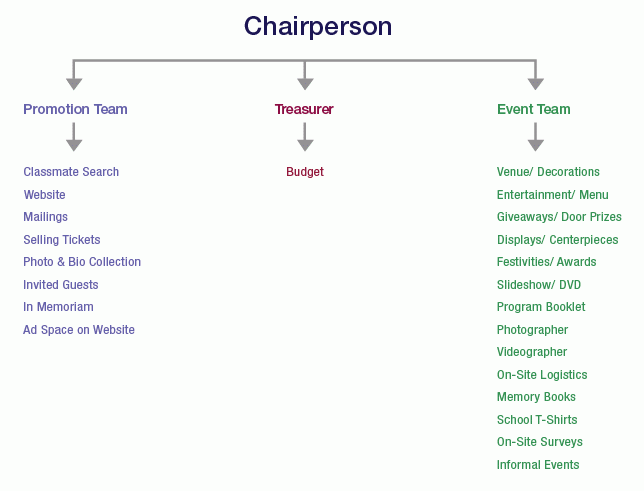
The Planning Committee can include as little as one person (not highly recommended) or several people, and it can include sub-committees as well. It is easier to manage smaller committees, but larger ones benefit from having more people to get things done. Remember that you can always enlist volunteers outside of the committee for non-decision-making tasks. It really does come down to assigning the various tasks to as few or as many people as there are on the committee. Whatever you decide, strong leadership from the chairman of the committee will be crucial for keeping everything and everyone on track.
To establish an effective committee, choose your members carefully. Anyone in the entertainment, hospitality or food service industries would be a great asset in planning the event. It is also wise to include business owners, as you may be able to approach their companies to pick up the tab for long-distance bills, postage, office expenses, prizes and more. We stress again the importance of including alumni from various social groups. The more diverse your committee (from cheerleaders to the chess club), the better the turnout. This is particularly relevant when it comes to getting the word out, something that all members of the committee must partake in.
How many committee meetings you have will depend on several factors, such as how much time you have left before the reunion, how big your committee is, and the size of the reunion you are planning. Committee members can have conference calls and update each other via email. However, meetings are critical to the success of the reunion. People will definitely be more proactive in fulfilling their responsibilities when a meeting deadline is coming up as opposed to a task simply written on a list. You cannot afford to have committee members procrastinate! Regular meetings are a good way to avoid this pitfall. We recommend meeting approximately every 8 weeks. You should look at the committee meetings as minireunions. It’s a good opportunity to reconnect with old friends and have a good time prior to the reunion.
Committee meetings are only useful if they have a specific purpose, so be very organized and come prepared with an agenda that has been distributed to the committee members beforehand. Everyone 11 should know what their responsibilities are ahead of time so that they can also come to the meeting prepared.
Although some committees attempt to plan everything as one unit, it can be far more effective to break this unit up into smaller groups, or teams. When dividing the workload, try to match people with tasks to which they are best-suited. Someone who works in advertising or public relations, for example, is well-suited to getting the word out. Business people may do well in negotiations with vendors. You may want to draw a diagram to help you sort out the chain of command, as well as the responsibilities of each team, and its members. Make sure people know which decisions can be made on their own and which decisions need the entire committee’s consultation.
You will always get better results when you assign tasks with specific goals and deadlines. A strong assignment would be: "Graham will check out potential venues and report back to the committee by January 15, detailing the top three choices, including pricing, and the pros and cons of each option.” This will be much more effective than “Graham will take on searching for a venue.”
Each task needs to have an “owner”. Assign a committee member (or in the case of team assignment, select a team leader) to each of the tasks. For each task, you will have a task description, the name of the committee member assigned to the task, committee expectations regarding the task, and a due date by which the task must be completed. This is a key factor in how successful the planning committee is in effectively managing their time.
We recommend the following breakdown of responsabilities:
If you have other responsibilities on your list and you are unsure which team should take them on, a good rule of thumb is: If the task involves spending money or the task is related to something that can be seen at the event, send it to the Event Team (Planning the Event). Conversely, if the task results in ticket sales or communicating with alumni, assign it to the Promotion Team (Getting the Word Out).
It is important to note that although one team is responsible for finding classmates, all committee members should be involved in the search. This is the most challenging and time-consuming undertaking you will face. After an initial search, the Promotion Team can assign the names of those still not found to the committee members deemed most likely to locate the individual.
At the final meeting before the event, everyone becomes one team unit again. As you map out the day of the event, assign individuals to each of the various tasks that require preparation (eg. preparing registration lists, prepping name tags, decorating, setting up displays, assembling registration kits, etc.).
The time periods mentioned here are based on an ideal scenario. You may need to adapt your timeline so that it reflects how much time you have left to plan your reunion.
Quick Reference Guide
12-18 months in advance:
8-12 months in advance:
4 -8 Months in advance:
1-3 Months in advance:
The Final Weeks:
Reunion Day:
Post Reunion:

Best Practices For Registrations
Many people want to know the best way to handle registrations, sell tickets, and manage RSVPs for their class reunion.
If you are using a reunion website, you do not have to use the RSVP page, but it can give you more information for planning purposes. When you first set up the website, the inclination for your classmates is to not buy tickets right away (though they should be encouraged to do so with a link to the Buy Tickets page). They are likely to want to wait and see who else says they will go and procrastinate paying for their ticket.
The concept behind the RSVP page is to that it gives you an idea of how many people plan to attend the reunion. Knowing how many people to expect can help in planning the various events of a reunion. As time goes by, you will end up with four lists of people.
List1
People who have not been contacted and who have not registered on the website. These people should go on the Missing Page (or in the "Missing" section of a page), and your classmates should be encouraged to direct these people to come to the website to Buy a ticket or RSVP.
List2
People who have registered on the website either on the Classmates page or via the Guest Book but have not RSVP'd or bought a ticket. You can follow up with these people to see what their intention is and encourage them to buy a ticket or at least RSVP one way or the other.
List3
These people have RSVP'd and said they will come to the reunion but they have not bought a ticket yet. You should follow up with these people and encourage them to buy a ticket.
List4
These people have bought tickets and can go on your Who's Coming page. You may want to wait to activate this page until after you have a certain number of tickets sold.
In order to stay organized, you need to create a tracking system that is always current. It is important that you generate lists of the four key groups mentioned above.
The Promotion Team’s goal is to keep classmates moving from List 1 towards List 4.
Once you have identified who is in which group, it is easy to target those in group 3, for example, by sending them a broadcast email reminder: “We noticed that you intend to come but have not yet purchased your tickets. Take advantage of our early bird offer and save $30 off the ticket price by purchasing your tickets today!”
When planning a reunion, people often wonder who will pay the deposits needed to hold the venue, caterer, and other services that require early payments for reservations. This section addresses how to deal with these issues, how to raise money and how to balance the budget.
Before we dive in, we stress the importance of standard accounting practices:
In the early stages of planning, create a preliminary budget in order to determine the scale of your event. You can do this even before you start searching for classmates. As the months pass, you will be able to update the information as decisions are made. If possible, get a copy of the previous event’s budget as well as actual revenue and expenses.
Step 1: estimate the number of paying guests
On average, 40% of classmates will attend the reunion and 50% of those will bring a guest. Therefore if you had a class of 300 people, your paid attendance will be 300 X .40 X 1.5 = 180 paying guests. Remember that this is just an average and that there are many things that can affect the turnout. The number can vary greatly depending on the milestone you are celebrating, how well you promoted the reunion, the personality of your class and many other factors. However, you need to start somewhere, so using an average figure as stated above allows you to begin budgeting. You can eventually use actual numbers based upon real answers from classmates as they RSVP and purchase tickets.
Step 2: Set a temporary ticket price
This ticket price should not be advertised until you’ve established a final ticket price.The average reunion ticket price is $75 per person, which is usually enough to create a special event, yet still be affordable. Some committees offer package deals for couples (ex. 2 tickets for $130). In one aspect, this is fair, as only classmates (and not dates) will get a full registration kit or memory book, but on the other hand, the savings of $20 is unlikely to bring in extra guests, so we advise against it.
Step 3: Do the math
40% of your class X 1.5 for guests, multiplied by the ticket price $75 (as an example) provides your main source of revenue. If we estimate out of a class of 300, 180 paying guests at $75 per person, the overall budget will be $13,500. Plan accordingly. Should you be able to revise ticket sales higher later on, you can then spend more on prizes or other things. Ticket sales will not be your only source of revenue. All additional income, however, will cover the ‘we forgot to budget for that’ expenses. Trust us, you’ll need it!
Step 4: Itemize and estimate expenses
If you don’t know how much live music costs, call a few bands and take an average as your estimate. This works with every category. Be practical in your planning. If your entire budget is $6000, you would be wise to opt for a DJ or prepared CDs rather than a live band. This is true for every expense. There is usually an expensive way or a frugal way to do just about anything. You need to decide what is most important to your class and spend the money on the deluxe things that will mean the most to your particular class.
Step 5: Finalize your ticket price
This is a committee decision. If you feel that $75 tickets won't bring in enough revenue, see what happens if you raise the ticket price. Conversely, if you think that a $75 price is too high, you will need to cut out certain things from the budget.
Step 6: Committee members buy the first tickets
At the first or second meeting, members of the reunion committee should buy tickets for themselves and their dates. These funds can be used towards deposit for venue, and up-front costs (such as postage, copies, website). If you haven’t finalized the ticket price, pay the temporary price and even up later on. If these funds are not sufficient, the committee members may consider loaning the reunion a certain amount, to be paid back once tickets start selling.
Example of a Preliminary Budget
If you don’t book a hotel or restaurant, remember to budget for caterer, tables, linens, tableware, dance floor, waiters, bartenders, chairs, audiovisual equipment, easels, and liability insurance. You can see why most committees opt for hotels!
The preliminary budget example on the previous page shows expenses and expected revenue on budget, which is where you want to be. If your expenses appear to be higher than your revenue you will need to remove (or reduce) some expenses, raise the ticket price or generate more funds through fundraisers, donations, and ads.
The budget is fluid and you can adjust as you go along based upon how much money you raise. You should definitely do your best to raise as much money as possible through ads, donations, and fundraisers because it will either help you prevent a shortfall or allow you to go all out for the reunion. You could use the funds raised from other sources to spend more on prizes, add valet parking, make a donation to your school, or keep the website going.
Ideas to Increase Ticket Sales
To create some cash flow, committee members buy the first tickets. If tickets are $75 and there are 6 committee members, and they all bring dates, you have generated $900 in start-up funds. This is easily done, as everyone planning the event understands the need for immediate cash flow.
Many classmates who intend to come, will wait until the last minute before buying their tickets. Whether this is due to procrastination or wanting to see who will come before committing, you should be prepared for it. You may want to step up the pressure in the weeks leading up to the reunion, especially to those that indicated an interest but have not yet bought their tickets. There have been many reunion committees that were fearful of having a shortfall, only to find that in the last 2 weeks they sold 50% of their tickets. This stresses the need for the committee to buy tickets early because you may need some cash to get things going.
Here are some tips on how to encourage buying tickets sooner rather than later. Remind people that purchasing tickets is easier than ever. Taking a minute to go online and pay by credit card is much simpler than writing a check and sending it in by snail mail. Online payment is the fastest way for the funds to get in your account, so consider it your #1 choice of payment. MyEvent.com allows you to make direct deposits right into your reunion bank account. In addition to making it easier for your classmates, you will save yourself a trip to the bank by selling tickets on your website. As already mentioned, since so many people elect to buy tickets late, you will want to keep this easy option available as late as possible.
You may want to set up a three-tier price system based on deadlines. For example, if your event is on June 20, 2010, offer an early-bird rate of $60 if tickets are purchased before December 31, 2009. A second, ‘regular’ rate of $75 can be offered until May 1st. Anyone who purchases tickets following the May 1st deadline will be charged $85.
Organize an early-bird draw. The first 50 people to buy their tickets will be eligible to win a prize. The prize can be donated, or it can be as simple as a free ticket to the reunion.
Remind people that there is a final cut-off date to purchase tickets. Depending on whether or not your venue can accommodate last minute guests, you may offer a higher rate for classmates who want to buy tickets at the door. If you do decide to offer ticket sales at the door, (be sure to work this out in advance with the caterer), publicize that you cannot guarantee last-minute registration kits. If people come to the event following the meal, you may reduce their cost of the ticket by the cost of the meal.
Some committees ask classmates for non-refundable deposits towards their reunion ticket, one year before the reunion takes place. This is a good way to ensure you have enough cash on hand for up-front expenses.
The downside of saying that deposits or tickets are non-refundable is that it encourages people to wait before buying their tickets. Some classmates may be concerned that the reunion will not happen and they will lose their money. You really don’t want to give people any excuses to procrastinate, so we strongly recommend a full refund policy since it encourages early ticket sales.
At your first committee meeting, decide if you will be inviting any non-paying guests. Do you want to include the beloved math teacher, the basketball coach, the principal? It is common courtesy to offer each person two tickets at no cost.
The more revenue you collect, the more there is to spend. Just because you based your budget solely on estimated ticket sales, does not mean you should not try and raise money through other means. The funds you generate through other avenues can either offset a shortfall or be used to add more value to the reunion.
7 Sure-Fire Ways to get hold of some Extra Cash!
1. Sell ad space (website, program, memory book)
This is easy and requires little effort. Send a broadcast email to your classmates, and try and sell advertising to your vendors as well. After you have negotiated your best price with a vendor, try to get an extra 5-10% discount in return for a position on the website and in printed materials. You can offer different level sponsorships for different amounts. This can either be done by size of ad or by level (gold, silver, bronze). You can also approach businesses that have a vested interest in the community. Ad space on the website, in the Memory Book, in the program, and atthe- event signage can all be components of various advertising packages, according to the amount of the donation.
2. Put effort into three areas: donations, donations, donations
There are two types of donations; cash and anything else that you can use or give away as a prize. A good place to start is the school. The school is certain to be a donor. They will usually agree to lend you the school banner and memorabilia for the displays. If you truly have no funds to work with, consider asking the school for the use of the gym or auditorium.
You can ask classmates for general cash donations towards the reunion, and the best way to do this is on the website. You may even get people contributing to the reunion fund who do not plan to attend the event.
There is a Donations page built right into your MyEvent.com website which is a great way for you to accept donations by credit card without a merchant account. All you have to do is click on Accept Donations in your Control Panel to get started.
You may find that there are some classmates that have done exceptionally well who want to give money back to the place where they started to become the successful person they are today. It is also a great way for people who cannot attend the reunion to give something back.
You can either raise money strictly for the event itself or for a special cause. Maybe there is a classmate who is in a particularly bad situation who needs help for a medical problem, or maybe you just want to raise money for the high school to be able to purchase new equipment. We recommend that the donation fund can be used for a combination of things, such as new equipment and enhancing the event.
Donations can take many forms. There are all different kinds of supplies and prizes that you need to have a successful reunion. Classmates will not donate if they do not know what is needed, so it is important to list what you are looking for on a page on your website and keep it updated.
Donations can include everything from postage to balloons to prizes and items to be given away at a silent auction. Inform classmates about the list. Keep it clever and continue to throw in some improbable and funny requests, (such as a mechanical bull). This will get classmates visiting the page regularly, out of curiosity. Once each item is secured, indicate so on the website and include the name of the donor. You can also have a blanket request for ‘Anything that might be neat to include as a giveaway in the registration kits.’ This is a fantastic way for alumni business-owners to contribute their product or promotional items. It also opens the door for a hodgepodge of truly surprising treats for attendees - registration kits have been known to include everything from lingerie to calculators to ball-caps.
3. Negotiate with Vendors!
Depending on when you are having your event there may be room for negotiation (if it is not at a busy time of year for the vendor). It is always a good idea to get more than one quote for each service and then try and play each one off the other to see who will give you the best deal. As already mentioned, once you have what 28 you think is your best deal, try and get an added discount in exchange for advertising.
Fundraising opportunities abound at the reunion itself. When selecting from the list below, keep in mind the work involved in relation to the payout.
4. Hold an online auction
This requires some effort soliciting donations as well as setting up displays of the auction items at the event. If you received donations in the form of goods and services, this could be a good place for those items. Local restaurants are often willing to give gift certificates for this purpose because it can draw in new clients as well as getting some exposure at the event.
You will need a sheet of paper that describes each item with space for people to write their name & bid amount. It is a good idea to have a list that describes all the items, and to give them out at registration. To simplify the work involved, auction off memorabilia that is already at the event. People can even bid on the enlarged photo of your school class. If committee members have old sports memorabilia that they no longer feel attached to they can include those items in the auction as well.
5. Set up a raffle
Although this also requires soliciting donations, it is less work than an auction. Set up a small table at the event (preferably at registration as well) where people can buy tickets. Have a sign ready detailing the prizes and the ticket price. You can also send a volunteer or committee member to sell tickets throughout the night.
6. Hold a 50/50 draw
This requires almost no effort, and can be arranged at the last minute, as long as you have a roll of tickets on hand. The idea is similar to a raffle, but the one prize is 50% of the money generated by selling tickets. So if you sell 100 tickets at $5 each, the winner of the draw will get $250 (half of $5 x 100), and $250 will be raised for the reunion. The 50/50 is a guaranteed hit, and there is almost no prep involved.
7. Sell drink tickets
If you need to cut costs, forget the open bar. Instead, each guest can receive two complimentary drink tickets. If they would like more, they can buy additional drink tickets for a minimal amount ($2 or $3). These can be used for beer, wine or mixed drinks. This not only brings in additional funds, it also makes people more aware of their alcohol consumption.
All of these fundraising opportunities seem to do better as the night progresses. As the liquor flows people are known to become more generous, so do not wrap up any of these efforts too early if you are serious about raising money. This may be particularly important if these efforts are required to balance the budget. In that case you may want to do more than one of the above.
Make sure there are many options for people not to drink and drive. This can involve the availability of taxis, designated drivers, or a hotel nearby to stay overnight.
An important task for all committee members is promoting the event. If anyone on the committee works in advertising, public relations or promotions, have them lead this effort. Finding classmates is your first priority. Once you have started locating people, the focus changes to gathering bio information and selling tickets.

As mentioned in Chapter 1, the classmate search starts with a trip to your old school. Try to obtain a complete list of your graduating class. This will ideally include their telephone number and address at the time of graduation. Hopefully, this will also include names of parents. Some schools may keep current contact information for any alumni who have inquired about upcoming reunions.
If the school does not have a class list, use your high school yearbook as a reference. Nowadays, many high schools have their own website since having an online presence has become so prevalent. You can ask your school to put a link to your reunion website on the high school website, and to mention the upcoming reunion in any newsletters.
Once you have a master list of names, you can create a page on your website that lists them. We recommend having another section of that page for those classmates that have been found. This can be done using a different section, using different colors, or even placing the list of found classmates on another page altogether. Make sure to keep a record of both married and maiden names. A word of caution - if someone is reported as deceased, make sure to verify the information before listing them as such.
Finding your classmates is one of the most important parts of planning the reunion because without your class there is no reunion! We recommend that everyone on the committee share the responsibility of searching for former classmates and spreading the word about the reunion. Now that social networking sites like Facebook, LinkedIn and Twitter have become so prevalent, getting the word out has truly never been easier.
The 7 Best Ways To find your classmates
1. Word of mouth
Each member of the committee should telephone or email classmates they still know from school, and inform them about the reunion. Classmates should be encouraged to visit the reunion website to submit their profile, and help spread the word to those with whom they are still in touch.
MyEvent.com has social media tools integrated into each page of its reunion websites so visitors to the site can inform their networks about the event with a click of their mouse. Given the viral nature of social networks, it only takes an instant for that message to get passed on to someone else’s social network, who in turn will forward it to their network, and so on. Before you know it, word of mouth has reached an exponential number of people some of whom will surely be your former classmates!
2. Missing Classmates Page
The website is a great way to get all of your classmates involved in the search. Remember to update it regularly as more of your classmates are found. You can issue a Classmate Challenge and award points to classmates for each person they find. The winner of the challenge can be acknowledged at the reunion with a special award or a free ticket to the reunion.
3. The telephone book
Most adults live in the town where they grew up, so this is worth a try. When you get a wrong number, inquire if you are speaking to a relative of the classmate as this can end up being your next lead. You can also try online versions of the phonebook. Whitepages.com (US and Canada) or Canada411.ca (Canada only) are good resources.
4. Search the Internet
You can search on peoples’ names using search engines like Google and sometimes come up with the information you are looking for. Social networks like Facebook, LinkedIn, Twitter and MySpace are also great resources to try to find lost classmates. Remember to search on a classmate’s married name as well as their maiden name since they may have set up their social network profile using either one.
5. Run an ad
This does cost money, but most parents and family still live in the area, so many classmates are sure to hear about the reunion. Include the reunion website address so they know where to go for more information. Some newspapers (especially community-related newspapers) may have a section that allows for these kinds of announcements for free.
6. List the event
This can be done through community affairs announcements on local radio and television stations, through bulletins at the town recreational center, the church, the fire station, etc. You should also call local radio stations during prime time (morning and afternoon drives) and ask them to plug the reunion. Creating a Facebook group page for the event can help to spread the word in online communities. A link to the reunion website should be included on the Facebook group page.
7. Post flyers
You can do this at local stores and restaurants. Although this is free, it is timeconsuming. Make sure to include the reunion website address on the flyers so people know where to go to get more information.
Mix up your media! If you have a scanner, you can scan your flyer and upload it to your reunion website and Facebook group page. The more exposure the better. Let the power of social networking do its magic and spread the news for you. Try to maximize this by always encouraging visitors to share with their own social networks by clicking on the share icons located on each page of your reunion website.
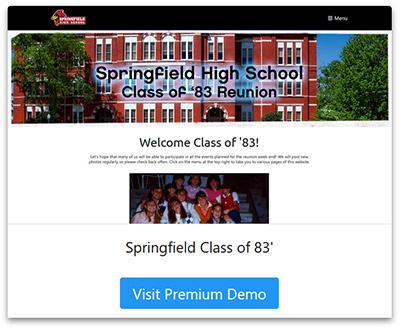
We mention the reunion website throughout this book because it applies to many aspects of your reunion planning. This chapter will deal exclusively with suggestions on how to get the most out of your class reunion website.
Assign a committee member to be the site administrator. This need not be a techsavvy person! Anyone can create an interesting and useful website with a reunion website builder. A reunion website serves many purposes.
5 BEST REASONS FOR HAVING A REUNION WEBSITE
If you have not already done so, you should take some time to explore all of the buttons and links on the main page of the class reunion website at myevent.com/class-reunions. Click on FEATURES to see all the things you can do with your reunion website, and click on TESTIMONIALS to see why MyEvent is the best choice for your class reunion website.
Classmates / Registration Page
This is where people can enter their contact information, 2 pictures (then and now) and tell everyone what they’ve been up to. On your home page, you should remind people to submit a profile on the page commonly called “classmates” (or “registration”).
Missing Classmates Page
Classmates visiting the site can get involved by helping to find the missing! On the home page of the website encourage visitors to see if they know anyone on the missing page and tell them about the reunion. Remember Word of Mouth is your best way to promote the reunion. You can use one of the “Extra Pages” (in your control panel) for this or use the home page. Simply type in the names of the missing people and update it regularly.
Memorials Page
Pay tribute to those classmates no longer with us with the “memorial page” (in your control panel). This page has special tools that allow you to enter an obituary, upload an image and allow others to pay tribute on the website.
Sponsorship Page
An excellent way to raise money for the event. Offer ad space on this page to classmates or vendors who give cash or prizes to benefit the reunion. Use an Extra Page (in your control panel) for this and create a “package” in your dashboard for the ad.
Purchase Tickets Page
Offering classmates the ability to purchase tickets online with a credit card is a great way to increase attendance at the reunion and reduce your workload.
Photo Albums
A picture says 1000 words. Providing your classmates with images from high school will go a long way to illicit feelings of nostalgia that are a key ingredient to helping classmates decide whether to attend the reunion. Great before and after the reunion and for those who could not come to the event. These are the pages we recommend you use on the MyEvent.com Reunion Website Builder.
Flashback Page
One thing your classmates will surely enjoy is a trip down memory lane. This includes a list of all the things that were current the year you graduated. You can find information about events of a particular year simply by doing a search on that year. It’s fun for everyone to see the pictures and content related to music, tv, movies, sports, and politics. Use an “Extra Page” (in your control panel) for this.
Questionnaire
This page (called "custom form" in your control panel) can be customized with all sorts of questions, that allow for answers in all formats (true/false, multiple choice, paragraphs…). It’s a great way to collect information for the memory book if you are planning on having one or to use in some games you will play at the reunion. The custom form is also a great survey tool if you want to get opinions about when to have the reunion or what theme everyone would like.
RSVP Page
When you first start planning the reunion, many classmates will be reluctant to buy tickets. The RSVP page is a good way to at least gage if people intend to come to the reunion. This can give you important planning information and give you a list to follow up with as the reunion approaches. Use “free” tickets to create an RSVP page if you are planning very far ahead.
Travellers Page
A very important page that conveys many important details about hotel accommodations, recommended restaurants, things to do and links about the city where the reunion is taking place.
Happy Birthday
Who can resist their own public birthday announcement? This can be done on a section of the home page or on an "Extra Page".
What’s New
Here classmates can post life events: engagements, marriages, new babies, grandchildren, honors, awards, etc. This can be done on a section of the home page or on an "Extra Page".
Reunion Tips
Include humorous lists on how to behave at the reunion, what not to do, how to mentally prepare. Keep them light and funny. This can be done on a section of the home page or on an "Extra Page".
With the increasing popularity of email, contacting classmates has never been easier or cheaper. Although some committees still rely on the regular postal service for some mailings, many have abandoned sending regular mail because of the cost and time it incurs. If you are using the website and getting people to register with their contact information (including email address), you will build a list that you can use to communicate for the months ahead. Some website builders like the one at MyEvent.com, have a built-in broadcast email function which facilitates this process (in the Dashboard, click on Promote and then Emails).
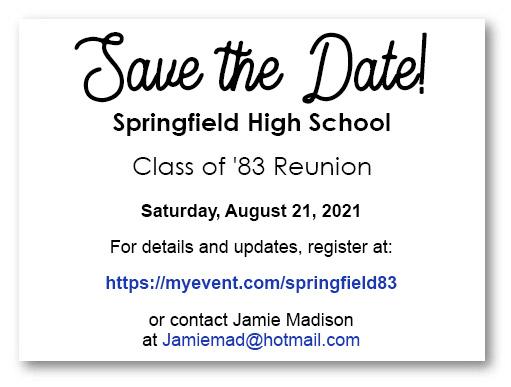
How you correspond with classmates will depend on how successful you have been at collecting information. If you managed to get a list of addresses and it is very early in the planning stage, it’s not a bad idea to send a Save the Date card (once you have selected the date of course) by regular mail. It may be the only regular mail that you send but it may be a good way to drive traffic to the website and get people to register so that you have their contact information later on.
Anything sent by snail mail should include the logo or school mascot on the envelope, or you run the risk of it being written off as junk mail. The first mailing helps find classmates, and puts a physical reminder of the upcoming event in their hands. If parents receive the notice, they will usually pass on the information. You will also get plenty of returned mail due to out-of-date addresses. Keep the returns and update your master list accordingly. This will help you create your Missing Classmates list.
Save the Date cards are usually sent by post, as you may not have peoples’ email addresses at this point. If you come from a small tight-knit class and most of you still keep in touch, you can simply send the Save the Date notice by email. Even if nothing has been planned yet, Save the Date cards let people know the following vital pieces of information:
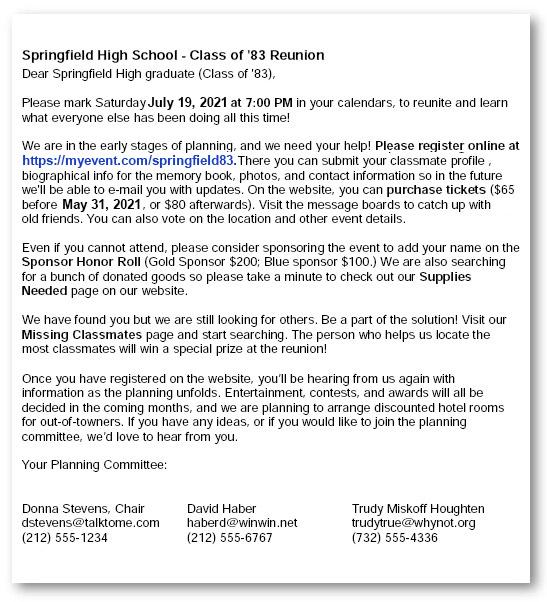
Announcement letters have the advantage of including more information than Save the Date cards, but the disadvantage of overwhelming the reader with too much information. If you choose this option, consider including:
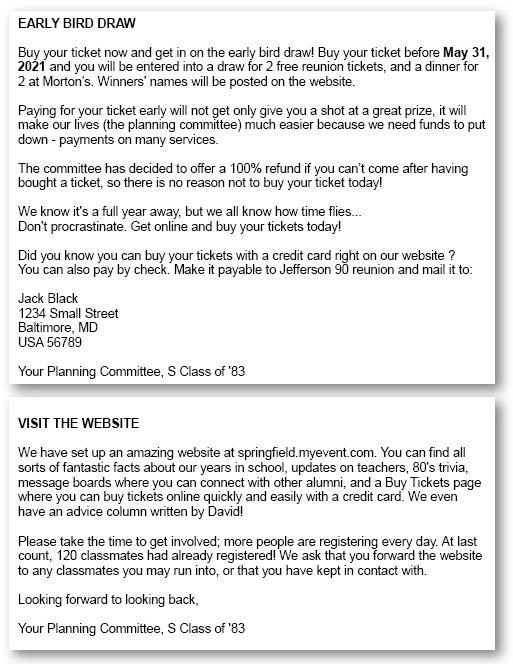
An invitation should be sent (either by post or email) once you have finalized the following details: place, date, time, dress code, cost, cut-off dates for purchasing tickets, and any details regarding additional activities on the same weekend. Once the invitations are sent, the big focus becomes selling tickets, as well as finding the missing classmates (as always). Below are a few sample emails that you might consider sending.
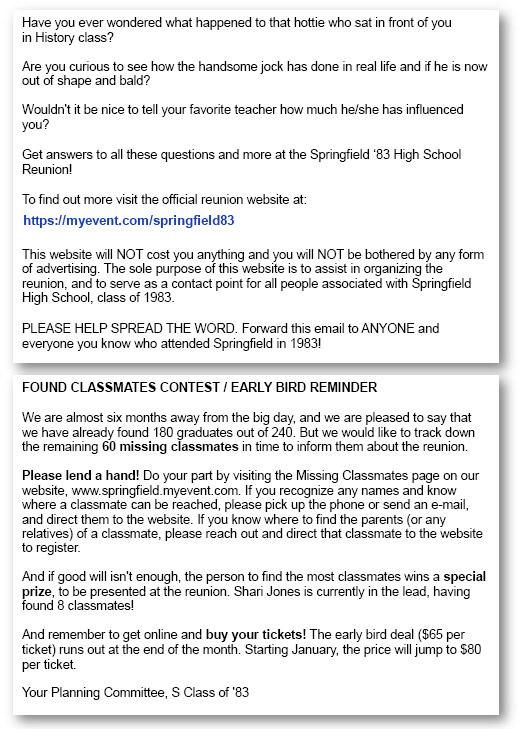
Use humour
The broadcast email below is good in a "save the date" email or anytime during the planning process...Using humour and piquing your classmates curiosity may push some people who are on the fence to come to the reunion!
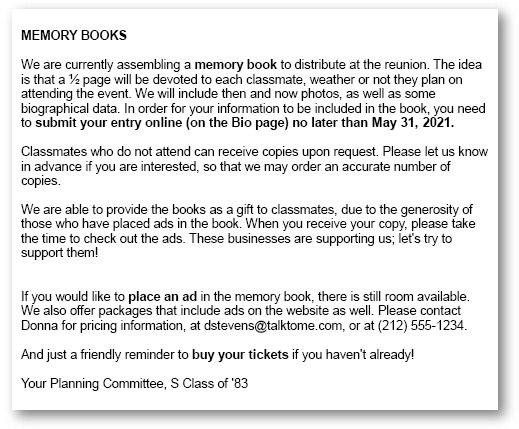
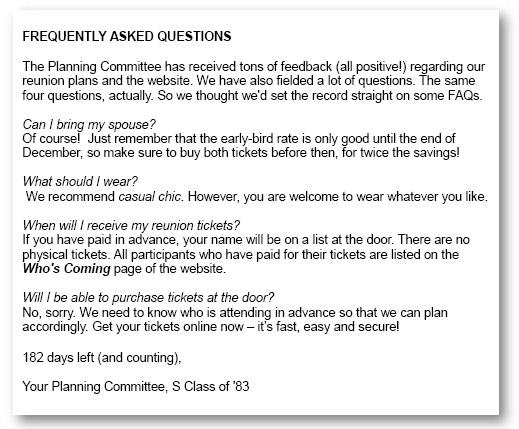

The success of a reunion depends on the turnout!
7 Best Strategies To Increase Attendance At Your Event
1. Be Persistent
Many reluctant people warm up to the idea with time, particularly if they know certain people have bought tickets. Encourage everyone to get people to come to the website to register and have everyone pass the word along to as many friends as possible.
2. Promote the Event
Announce the reunion at the high school basketball games or in the town parade. Take out an ad in the newspaper and do your best to get free publicity through local media. Many of your old classmates may have Facebook, Twitter or LinkedIn accounts. Leverage the power of social media by letting them promote the reunion for you! Activate the social media share links in your Control Panel so that the sharing icons appear on each page of your reunion website. Encourage visitors to your site to send word about the reunion to their personal networks.
4. Update the website
Make updates to the website regularly to keep classmates coming back. Get creative. Post daily quotes, pictures, and polls. Create a weekly trivia challenge and award token prizes. Ask classmates to reveal their favorite memories of school, and post a different contribution every week.
5. Call each classmate
Split the class list up among committee members. Nothing replaces a live person telling you they would like to see you at the reunion! This is time-consuming but highly effective. On the phone, you can immediately dispel any fears classmates may have about attending. If they don't know anyone who has RSVP'd, you can encourage them to reach out and try to promote the event to their old crowd.
6. Invite well-liked teachers and coaches
Many classmates have fond memories of special teachers who may have had an impact on their life and/or career. Knowing that they will be at the reunion creates an added incentive for those classmates who are still on the fence.
7. Create a Who’s Coming page
Wait until there is a hefty amount of tickets sold or RSVPs received before you post this information. Once you do, make sure to update it as soon as you receive additional RSVPs. People will be more likely to come to the reunion if they see that it will be well-attended.
8. Send broadcast emails
For many people the decision to come to the reunion is a process. The more reasons you give them to attend and the more nostalgia you throw their way, the more likely they are to come.
When
In the North-eastern and Midwestern United States, Summer is the most popular time of year for reunions, and the main reason is the weather. If you want to leave the possibility for picnics and other outdoor events at the reunion, then choose June, July or August. If you are in the southern states you may actually prefer non - summer months to avoid the extreme heat. Thanksgiving Weekend is also a common choice as it coincides with trips back home for many alumni.
When selecting a date for the big event, you will need to weigh the convenience of a holiday weekend (people may already be planning a trip home) against the inflated costs of a hotel's high season. Holiday weekends also tend to be booked earlier in advance (venue, entertainment, accommodations, flights), so if you do decide Thanksgiving is the right time for you, be prepared to book early! A reunion is typically scheduled on a Saturday night.
Where
If you are choosing a popular location on a holiday week-end you will need to book your venue at least 12 months in advance. So, where you have the reunion may be a function of what is available. But what place do you want? In our estimation, hotels are the way to go. They provide you with support and supplies that would otherwise be your responsibility. Need a microphone? No problem! Need an easel for your registration sign? They’ve got it! They have done this before and have the experience that you lack. Our next choice would be a restaurant, but make sure you have sufficient room for a registration area before you commit.
If you decide to choose a road less traveled (a gallery, or museum for instance), budget accordingly, and make sure that you have thought through the following list before signing on the dotted line: caterer, waiters and bartenders, tables, chairs, linens and dinnerware rentals, liquor license, audiovisual equipment, a screen for the slide show, registration tables, dance floor, washroom supplies, and liability insurance. You can learn a lot about a venue by visiting while an event is in progress, so take the time to see a live event if you can.
When you check out a possible venue, walk through it slowly. Imagine how you will divide the space for reception, registration, dining and dancing. Discuss decorating the walls, hanging a banner, and the equipment you might need: projector, screen, microphone, podium, easels, bulletin boards, and registration tables.
Choose a middle-of-the-road menu when looking at prices. Ask the hotel to give you a per person rate including open bar, and a per person rate without it. Find out the details of the cash bar option. How do they handle special meal requirements for those with allergies or special dietary requirements? Ask how it works if you decide to sell last-minute tickets at the door.
Once you have made your venue selection, try and negotiate the best price you can. If you are flexible with your dates, see if there is a quiet time for them that will reduce the costs significantly. Keep in mind though that the priority is to get a wellattended reunion, so give them dates that you have already determined will work for the majority of the class.
Position your reunion as a non-profit event and you may get a favorable rate. Verify what perks come included (if it is a hotel you may receive a complimentary suite for the evening, which comes in handy.) Find out the cancellation policy, liability insurance, hidden costs, overtime implications, etc. Remember to read the fine print before signing anything!
If the reunion is at a hotel, approach the hotel to arrange a special accommodations rate for out-of-town participants. If the venue is not a hotel, choose one nearby. Inform alumni about the special offer and any reservation deadlines that may be in place.
As you discuss the kind of ambience you want for your reunion, don't just think in terms of decorations. Many elements contribute to the overall mood of the night.
Theme
When setting the tone for your reunion, you do not need to plan a theme. Your event comes with a built-in theme! Help classmates reminisce about their school days by including graduation-year memorabilia as well as newsmakers from that era in the decorations.
Dress Code
A popular choice is casual-chic, which is pretty much what your classmates would wear when going out for dinner with friends.
Entertainment
Book your band or DJ as soon as you have confirmed the date of your reunion. Make sure their repertoire is what you are looking for, particularly if you would like to stick with tunes from your high school days. See them perform before you sign an agreement or contract. If you are working with a very small budget, consider asking a family member to DJ. Another option is burning pre-mixed CDs or loading up an mp3 player that can just play all night, if the venue has an adequate sound system. We suggest that you use the website to solicit music requests from classmates. Some committees rent karaoke machines, but don't rely on this as your only source of music.
Eating & Seating
Buffet is by far the wisest choice for most reunions. Aside from significant savings, it gives people the opportunity to mingle during the meal. Pre-arranged seating keeps the room static and limits each person's connections to only nine other people for a significant portion of the evening. Assigning the seating also becomes quite touchy and is best avoided. Many caterers and hotels now offer small food stations throughout the room, instead of the traditional long row of food. This minimizes line-ups and congestion at the buffet table, and makes it feel more like a chic event.
Top 7 Decorating Ideas
Decorations provide an opportunity for creating a nostalgic mood, and you need not spend a fortune. Keep it simple.
Top 7 Display Ideas
Every class creates a few unique displays for the reunion. Here are a few ideas:
Program Booklet
Some committees choose to have simple booklets that detail the order of events for the evening. You can also list the menu, contests, raffles and draws, award categories and recipients, as well as a quick word of welcome. Be sure to thank all sponsors and donors in the program. This can be as simple as one page folded in half or a few pages depending on how much content and advertising you have.
Top 5 Ideas for Video and Photography
There are many inexpensive ways to get good photographs and video footage the night of the reunion. Here are a few:
Satellite events
Depending on the amount of out-of-town guests you have, you may consider organizing additional events. The nature of the events depends on how long it has been since you graduated. A 10-year reunion might benefit from an informal 'Ice- Breaker' at a bar on Friday night, and a pick-up football game or pool party on Sunday. 20-year reunions often include a family picnic on Saturday or a Sunday pancake breakfast. Many reunion-goers also enjoy a round of golf on Sunday.
Out of town guests
If you have the resources, arrange welcome packages for classmates who are guests at the hotel. Be sure to include a list of all the classmates checking in. Deliver the packages to the front desk. When people check in, they are handed the package!

For each attendee, the main attraction to the reunion is other classmates. The most memorable part of the evening is getting reacquainted with old friends. Having said that, you are expected to plan some activities. There are ongoing activities, as well as an official program.
Top Ongoing Activities
Slideshow
Run a continuous slide show throughout the evening. You may be able to borrow a projector from the venue where you are having the reunion or from a committee member’s day job. Get a head start on this early by requesting photos in your first mailing, or through a special email announcement. You can also use the slideshow from your class reunion website in combination with a projector.
Wine cellar
Classmates who want to participate bring a bottle of wine. When they hand in the wine they get a special ticket. Draw a ticket during the program and someone goes home with a wine cellar! Remember to advertise this in advance, so people will know to bring bottles of wine.
Contests
Announce a contest for the best school-related story or memory, or hand out a high school-era trivia questionnaire. Solicit submissions throughout the night, and announce the winner during the program.
Official Program
Arrange a host for the evening. If no committee member feels comfortable, consider approaching the class valedictorian or class president. Ensure you have a working microphone set up.
Awards
People have come to expect awards at reunions. Keep them funny and light, and in good taste. The general rule is that if you have to ask if a certain category or prize is in good taste, assume it is not. If you give out gift certificates as prizes, make sure they are for national stores and restaurants. You will need to collect this information from your classmates through the website or through other correspondence.
Top 7 Ideas for Awards at the Reunion
Video
Video elements can include a now tour of the school and old hang-outs, interspersed with then footage, interviews of former teachers, and clips submitted by classmates who could not attend the event. If someone on the committee is experienced at shooting and editing video, this can be assigned to them as a task. Done well, it can be the highlight of the evening.
Brief remarks
The key word here is brief. Include a story or two from your school days. Take a moment to honor classmates who are no longer with us. Invite a teacher to say a few words. Announce the winners for any raffles, contests, and the wine cellar. Distribute the prizes and get on with the party!
Games
Here are three suggestions, but the possibilities are endless.
There are two kinds of giveaways associated with reunions: stuff that people win, and stuff that gets distributed to everybody (a loot bag full of goodies included in the registration kits).
It is a good idea to plan multi-purpose decorations. Some design centerpieces can also serve as prizes for contest winners. Awards can be records, movie posters, games that are already adorning the hall. If you have the extra time, it is always fun to arrange gag gifts for the awards: diaper pins for newest parents, a bottle of aspirin for parents of triplets, some golf balls for first to retire, to name a few.
When you are arranging the loot bags for the registration kits, donated goods need to meet a few criteria: If it is free, legal, and does not offend, include the item in the loot bag. When ordering or creating custom souvenirs, however, try to choose simple yet practical items, which will not show up in next week's trash. You should place an order for any customized items at least 3 months in advance. Here are some nostalgic ideas that don't break the piggy bank.
Top 6 Giveaways at the Reunion
Memory Books are the true souvenirs of a reunion.They are also known as photo books or programs. They can be distributed at the reunion or sent out postreunion, and may be hardcover, soft cover or on DVD. This will take time, persistence and a constant gathering of information every time you make contact with a classmate. If the book will be printed, check out pricing in advance. Make sure to weigh the value versus the cost, as hardcover books cost far more than soft cover. DVDs are great if you don't have the time to prepare. Your final text should be ready to go to the printers one month in advance, and allow plenty of time for proofreading.
Here are some elements you might want to incorporate:
If you give Memory Books as a gift to attendees, consider sending complimentary copies to those who could not attend. This may boost attendance at the next event! If you are selling the book, advertise it to those who were not at the event as well.
Planning an event well involves thinking ahead. The more prepared you are, the smoother your evening will run. The following are must-haves before the day of the event:
Layout Diagram
Create a diagram that indicates where you want to place the reception area, registration area, tables, bar, food stations, displays, etc.
Schedules
You can never have enough schedules! Create a schedule for everything, from the initial set-up through to each event planned for the reunion. Give a copy of each schedule to all volunteers and speakers.
Decorations & Supplies
Remind the volunteers when to be at the hall. Have lots of tape on hand, as well as staplers and scissors.
Displays
You can prepare most displays ahead of time.
Signs
Prepare signs that you might need: Registration, 50/50, Raffle, Trivia Contest, Wine Cellar, Drinks, Sponsors, Honor Roll Members, etc.
Lists
Have lists for everything that has to be tracked. For example, master class list, sponsor list, paid list (include names of spouses), etc.
Name tags
Use a large bold font, include maiden names and the person’s yearbook photo. Guest and spouse badges should have an easily identifiable look, so that people do not assume this is someone from school that they just don't recognize. Be prepared to create some tags on the spot for last-minute corrections and additions.
Registration kits
Each registration kit could contain items such as the current class directory, the planned program for the evening, a Memory Book, a loot bag, name tag(s), and drink tickets. You can prepare generic kits and keep the name tags separate, or you can alphabetize the kits for easy distribution. Often, the loot bags will be handed out at the end of the evening, so that people are not bogged down with them during the event. As such, you might want to keep these separate from the main registration kit as well.
Giveaways
Confirm that all deliveries and pick-ups will happen according to expectations. You will need your beverage and raffle tickets, as well as anything that will be used for games, contests and awards that you have planned.
Set-Up & Take-Down
Even if you have done your homework and are expecting the set-up to be a breeze, there will inevitably be some small bumps the day of the event. Allow time in the schedule for the unforeseen. Start early in the day so you don't feel rushed. Store reusable items for future reunions.
Registration / check-in
Properly think through and plan the registration process. When guests arrive, they receive registration kits and name tags, as well as any special papers, tickets or questionnaires that relate to contests or games you are planning. Highlight their names on your guest list as they check in.
If you have a no-tickets-at-the-door policy, and classmates do show up hoping to join in the fun, try to accommodate them. If this cannot be worked out with the caterer, suggest that the guests return after the meal for a discounted price. Keep track of any money you receive and issue receipts.
Don't bog yourselves down by running the check-in desk. Get a trusted volunteer for the night. Supply them with all the lists and information they need, and be available to them should any issues arise. They will also need some office supplies on hand (eg. pens, pencils, markers, scotch tape, masking tape). Make sure there are a lot of pens! People will be borrowing them all night to collect signatures in their Memory Books.
Any tables that deal with currency will need a cash box that includes a float. A fl oat is a sum of money that you keep in your cash box at the beginning of the event so that change can be provided. It is then subtracted from the total at the end of the evening when calculating the cash received. Raffles and contests will need ticket collection boxes. It is a good idea to always have at least one person (preferably two people) at the table with the cash box.

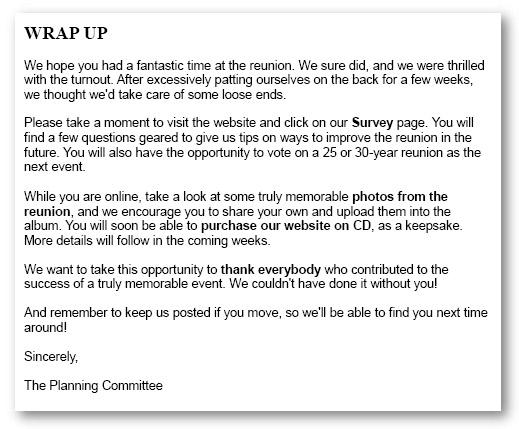
The reunion is over! Your job is done! Well, almost. First there are some loose ends that need to be tied up:
Planning a reunion is a milestone event that everyone who attends will remember for many years to come. Your goal is to rekindle relationships that have been dormant for a long time, and create a wealth of new memories for your classmates. Hopefully the ideas in this book will help you plan the best reunion possible so that it was a positive experience for everyone.
Please send an email to info@myevent.com if you have any unique ideas that you did not find in this book, or if you found the book helpful and you would like to send us a testimonial.